| Most viewed - Heritage |
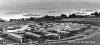
Navy prepares1291 viewsA rare World War Two photograph taken from Portkil, Kilcreggan, looking at a battleship and several cruisers in the Clyde between Portkil and Greenock. Donated to the Heritage Trust by Michael Wilson, the image is thought to be of vessels assembling for the North Africa landings in 1943.
|
|
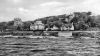
Cove villas1291 viewsVillas in Cove pictured from the sea. Image circa 1932.
|
|
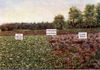
Agricultural Trial1290 viewsAn unusual picture of a mossland reclamation experiment conducted by the West of Scotland Agricultural College at Daligan Farm, above Helensburgh. The two plots were dressed the previous year with Quicklime, at a rate of four tons per acre, and it is claimed that the increase in potato crop in the left hand plot thanks to Albert's Basic Slag and Potash was enormous, with 6 tons 6 cwt of potatoes per acre, valued at £2 per ton. Image date unknown.
|
|

East Clyde Street1289 viewsThis 51 x 74 cms watercolour of East Clyde Street by John Carlaw (1850-1934) was used on the cover of the Helensburgh Heritage Trust book '200 Years of Helensburgh', published to mark the burgh's bicentenary. The artist, a friend of the late Victorian painters of the 'Glasgow School', lived at Seacliffe, 112 East Clyde Street, some 200 yards from where this was painted.
|
|
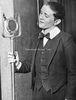
Master Joe Petersen1289 viewsMaster Joe Petersen, billed as 'The Phenomenal Boy Singer', was in fact Mary O'Rourke, born at 6 Maitland Street, Helensburgh, on July 26 1913, the 12th of 14 children of Hannah O’Rourke and her Irish mason’s labourer husband Joseph, who were married in the town on September 16 1892. As Joe, she rose to become a British and continental recording star from 1933 to 42, and in her later years remained a stage favourite in Scotland until she died of bronchitis in Glasgow on Christmas Eve 1964 at the age of 51. Image copyright Herald and Times, Glasgow.
|
|
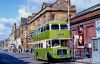
Garelochhead Coach Services bus1289 viewsA green Garelochhead Coach Services Regent bus, MSN 863G, is pictured outside Helensburgh Central Station. Image, date unknown, is copyright David Christie.
|
|
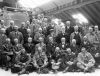
Water trip1289 viewsHelensburgh town councillors and officials at the opening of the Sinclair Street water pump house on June 10 1926. This was part of the annual inspection of the waterworks, and the company then went on to Glen Fruin but "on arrival here a heavy fall of rain made it undesirable to visit the source of supply, and the usual game of pitch and toss having been played and refreshments partaken of, the journey continued to Aberfoyle. Once there luncheon was served in the Bailie Nicol Jarvie Hotel". Image donated to the Heritage Trust by John Stirling whose father James N.Stirling is in centre of the back row. His father was the burgh surveyor and water engineer, taking up the post in 1912 and continuing until 1946.
|
|
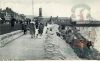
West Esplanade1288 viewsLooking towards the pier with the putting green to the left.
|
|
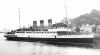
TS Saint Columba1288 viewsThe 785-ton turbine steamer was launched on April 9 1912 at the yard of William Denny & Bros Ltd., Dumbarton. Placed on the Campeltown run in succession to her namesake, she was requisitioned as a troop transport ship from 1915 to 1919 during which time she rammed and sank a German U-Boat. After the war she served Campbeltown, Inveraray and Ardrishaig until World War Two, when she was an accommodation ship at Greenock. She returned to the summer Ardrishaig service from 1947 until the end of the 1958 season, but was withdrawn and scrapped shortly afterwards. She is pictured arriving at Rothesay, circa 1950.
|
|

Colour television1288 viewsOn July 3 1928, John Logie Baird achieved colour television for the first time. The camera and receiver were modified versions of the mechanically scanned system first demonstrated by Baird in January 1926. Two months later he demonstrated his new discovery to a scientific audience in Glasgow at the annual meeting of the British Association for the Advancement of Science. The picture is an artistic reconstruction done in 1949 of the July demonstration at his company’s laboratory in London.
|
|
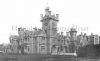
Shandon Hydropathic Hotel1287 viewsOriginally West Shandon, this magnificent building was the home of Robert Napier, the greatest figure in Clyde shipbuilding and marine engineering in the mid-19th century. During World War One the Hydro became a hospital, and in World War Two it was used by the army. In 1951 it became a hotel again, but in 1957 it was closed and demolished. From the image collection of the late Nan Moir, of Cove.
|
|

Craigendoran Pier1287 viewsA Tuck & Sons Oilette postcard of Craigendoran Pier, circa 1907, painted by Henry Wimbush, who was most active in painting between 1881 and 1908 when he lived at various addresses in London. Like many of his contemporaries in the Tuck's postcards stable, he toured Britain for inspiration and his coverage was far more comprehensive than many of the other Tuck illustrators — including a number of Clyde scenes. His watercolours were published by Tuck between 1904 and 1908, the majority in the Oilette series.
|
|
| 2190 files on 183 page(s) |
 |
|
|
|
|
87 | |
|
|
|
|